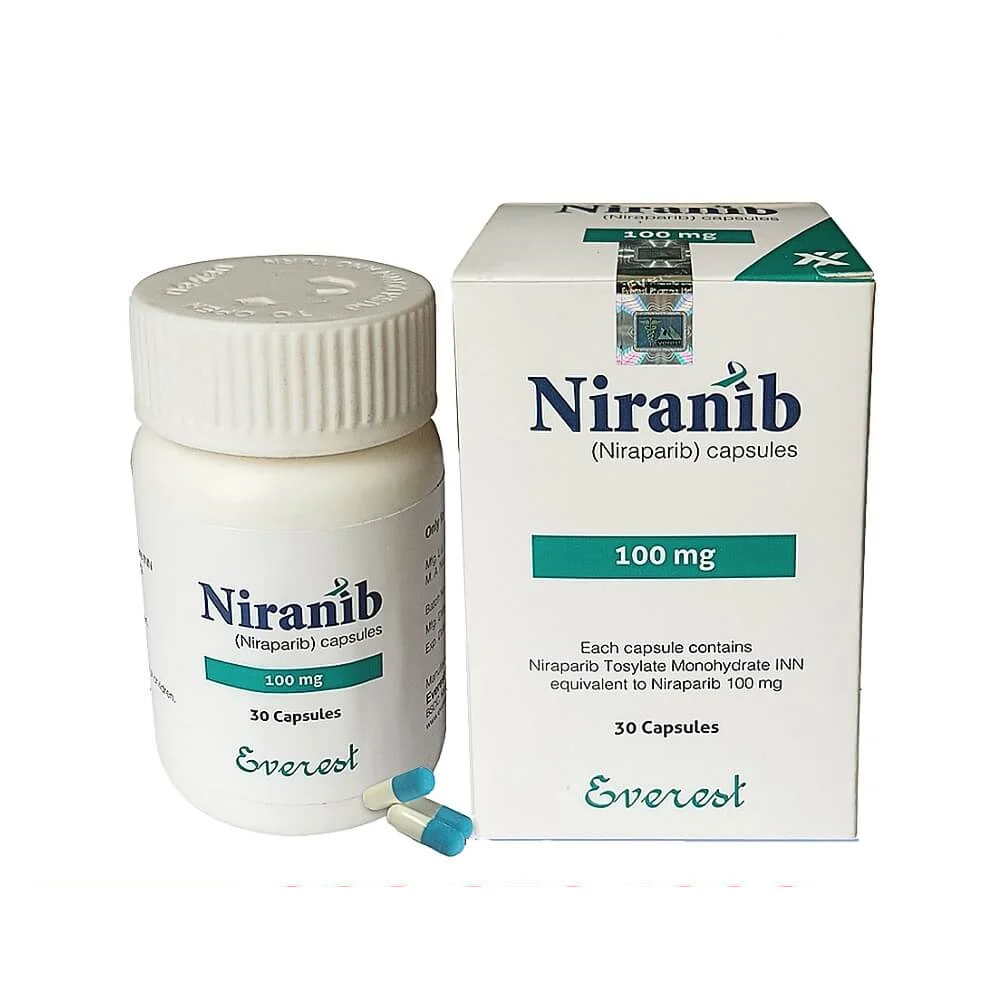

Niranib 100mg Capsule (Niraparib)
 Prescription Required
Manufactured By
Everest
Pack Of
30
Salt Composition
Niraparib
Storage
Keep in cold place

Fast Delivery

Easy Returns

Secure Payments

Up to 60% Discounts
ALL SUBSTITUTES

Zejula 100mg Capsule
Overview
Niranib 100mg Capsule is a prescription-based anticancer medicine used as maintenance treatment for advanced ovarian cancer, fallopian tube cancer, or primary peritoneal cancer. The active ingredient of the Niranib is Niraparib, which belongs to the drug class of poly(ADP-ribose) polymerase (PARP) inhibitors. It works by blocking the action of PARP enzymes that repair damaged DNA in cancer cells. It prevents the cancer cells from repairing themselves, which leads to their cell death. This action can cause a decrease in cancer progression and cancer load.
The capsule must be taken orally and swallowed whole with water and should not be crushed, chewed, or opened. The prescribed dose and duration of the Niraparib 100mg capsule depend on the patient's condition and response to treatment. It can also be taken with or without food. Patients are advised not to change the dosage and timings prescribed by the doctors because it can cause severe side effects.
Common side effects include nausea, fatigue, constipation, vomiting, abdominal discomfort, headache, dizziness, decreased appetite, and changes in blood cell counts. A few patients can undergo severe side effects, including severe anemia, low platelet or white blood cell counts, high blood pressure, heart-related complications, and rare but serious bone marrow disorders. Most of the Niraparib 100mg capsule side effects can leave when the body adapts to the medicine. However, report to your doctor if you experience serious side effects.
The medicine may cause fetal harm and should be used during pregnancy after the doctor advises. Women who can become pregnant should use effective contraception during treatment. Patients must list all medicines, supplements, and herbal products that they are taking. The Niraparib 100mg capsule must be used under medical oversight or medical supervision only. Attend regular tests and follow-ups to monitor the medicine response and reduce side effects. Before making any adjustments, changing the dose, or stopping the treatment, consult with your doctor to maximize the benefit.
Quick Product Facts
| Field | Publication wording |
|---|---|
| Brand | niranib |
| Generic / Active Ingredient | Niraparib |
| Strength | 100 |
| Dosage Form | Capsule |
| Manufacturer / Marketer | Everest |
| Pack Size | 30 |
| Prescription Required | Yes |
| Therapeutic Categories | Cancer Medicines |
| Uses | Ovarian Cancer |
Uses and Indications
Head and neck cancer, kidney cancer, lung cancer, liver cancer, skin cancer
Side Effects of Niranib 100mg Capsule
The human body shows undesired symptoms after taking Niranib 100mg Capsule (Niraparib). Usually, they disappear with time as the body adjusts to the medicine. These side effects don't need special medical attention. It is advised to consult your doctor if these symptoms become unmanageable.
Some of the common side effects of Niranib Capsule are mentioned below:
● Nausea and vomiting
● Rash
● Diarrhea
● Dizziness
● Headache
● Muscle pain
● Stomach pain
● Constipation
● Bladder infection
● Decreased appetite
● High blood pressure
● Changes in your urine color
● Tiredness and trouble sleeping
● Lung problems, such as shortness of breath and cough
● Changes in blood levels including red blood cells, white blood cells, and platelets
Niranib 100mg Capsule Dosage and How To Take It
Niranib 100mg Capsule (Niraparib) is a prescription-based anticancer drug that should be administered orally. Niranib is taken orally with or without food as per the doctor's advice.
It is consumed at the same time each day for better results. It is recommended not to crush, chew, or split the capsule, take it as a whole.
Safety Advice for Niranib 100mg Capsule
- ● Alcohol: The interaction of alcohol with this drug is still unknown. It is advisable not to consume alcohol while taking Niranib 100mg Capsule (Niraparib). It is advised to consult your doctor for further information.
- ● Pregnancy: Niranib 100mg Capsule (Niraparib) may be considered unsafe during pregnancy. Please consult your doctor in such condition.
- ● Breastfeeding: Niranib 100mg Capsule (Niraparib) is probably not safe if you're breastfeeding. Kindly consult your doctor.
- ● Driving: It is advisable not to drive or operate heavy machinery as you may feel dizzy after taking Niranib 100mg Capsule (Niraparib).
- ● Kidney: Share your medical history with your healthcare expert in case of kidney disease before taking Niranib 100mg Capsule (Niraparib).
- ● Liver: Inform your doctor before starting Niranib 100mg Capsule (Niraparib) if you have liver disease to avoid any serious side effects
FAQs About Niranib 100mg Capsule
Why do doctors prescribe Niranib 100mg Capsule (Niraparib)?

This medicine is given to patients diagnosed with advanced ovarian cancer, fallopian tube cancer, or primary peritoneal cancer.
What is the right way of taking the Niranib 100mg Capsule (Niraparib)?
Niranib 100mg Capsule is taken orally with or without food as per the doctor's advice. It is consumed at the same time each day for better results. It is recommended not to crush, chew, or split the capsule, take it as a whole.
What are the commonly observed side effects of Niranib 100mg Capsule?
The most common side effects of this medicine include Diarrhea, Headache, Tiredness, Mouth sores, Muscle or joint pain, Stomach pain, and difficulty breathing. It is advised to go for regular liver function tests to examine it.
Who should avoid taking Niranib 100mg Capsule (Niraparib)?
People diagnosed with severe liver and kidney disorders are advised to consult their healthcare professionals before taking this medicine.
Can the Niranib 100mg Capsule (Niraparib) be given in combination therapy with other medications?
No, there are chances that Niranib may interact with certain drugs. It is crucial to inform your healthcare expert if you're already taking any medication.
References
● Liu, M. C., Sutedja, J., & Tewari, K. S. (2021). Niraparib in the maintenance treatment of advanced epithelial ovarian, fallopian tube, or primary peritoneal cancer: safety and efficacy. Expert review of anticancer therapy, 21(5), 475-480.
● Kerliu, L., Myruski, S., Bhatti, A., Soni, P., Petrosius, P., Pervanas, H. C., & Horton, E. R. (2020). Niraparib for the treatment of recurrent epithelial ovarian, fallopian tube, or primary peritoneal cancer. Annals of Pharmacotherapy, 54(10), 1010-1015.
● González-Martín, A., Pothuri, B., Vergote, I., DePont Christensen, R., Graybill, W., Mirza, M. R., ... & Monk, B. J. (2019). Niraparib in patients with newly diagnosed advanced ovarian cancer. New England Journal of Medicine, 381(25), 2391-2402.
● Smith, M. R., Scher, H. I., Sandhu, S., Efstathiou, E., Lara, P. N., Yu, E. Y., ... & Moon, H. (2022). Niraparib in patients with metastatic castration-resistant prostate cancer and DNA repair gene defects (GALAHAD): a multicentre, open-label, phase 2 trial. The Lancet Oncology, 23(3), 362-373.
● Ison, G., Howie, L. J., Amiri-Kordestani, L., Zhang, L., Tang, S., Sridhara, R., ... & Pazdur, R. (2018). FDA approval summary: niraparib for the maintenance treatment of patients with recurrent ovarian cancer in response to platinum-based chemotherapy. Clinical Cancer Research, 24(17), 4066-4071.
● Scott, L. J. (2017). Niraparib: first global approval. Drugs, 77(9), 1029-1034.
Marketer Details
Everest
Author Details

Written By:
Nonish Sharma
I am a medical content writer with a strong academic background in life sciences, holding an M.Sc. in Biotechnology... Read More

Reviewed By:
Vaibhav Shakya
Dr. Vaibhav Shakya, MD, is a Medical reviewer and medicine expert at Globans Pharma, with more than 9 years of experienc... Read More
Want to know More
Check our Editor Policy
Disclaimer
Globanspharma main goal is to ensure that its consumers get correct, authentic, and reliable information that has been examined by medical professionals. This website's content has only been created for informational purposes. However, this is not meant to replace the medical advice and treatment given by a qualified physician. The information presented herein may not cover everything about particular lab tests, medicines, and health conditions, all possible side effects, and warnings. Please discuss all your queries related to any medication and illness with your doctor. We intend to support and maintain the doctor-patient relationship, not to substitute it or take its place.