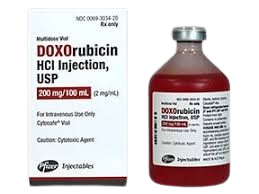

Doxorubicin Hydrochloride 200mg Injection (Doxorubicin Hydrochloride)
 Prescription Required
Manufactured By
Pfizer
Pack Of
1
Salt Composition
Doxorubicin Hydrochloride
Storage
Keep in cold place

Fast Delivery

Easy Returns

Secure Payments

Up to 60% Discounts
ALL SUBSTITUTES
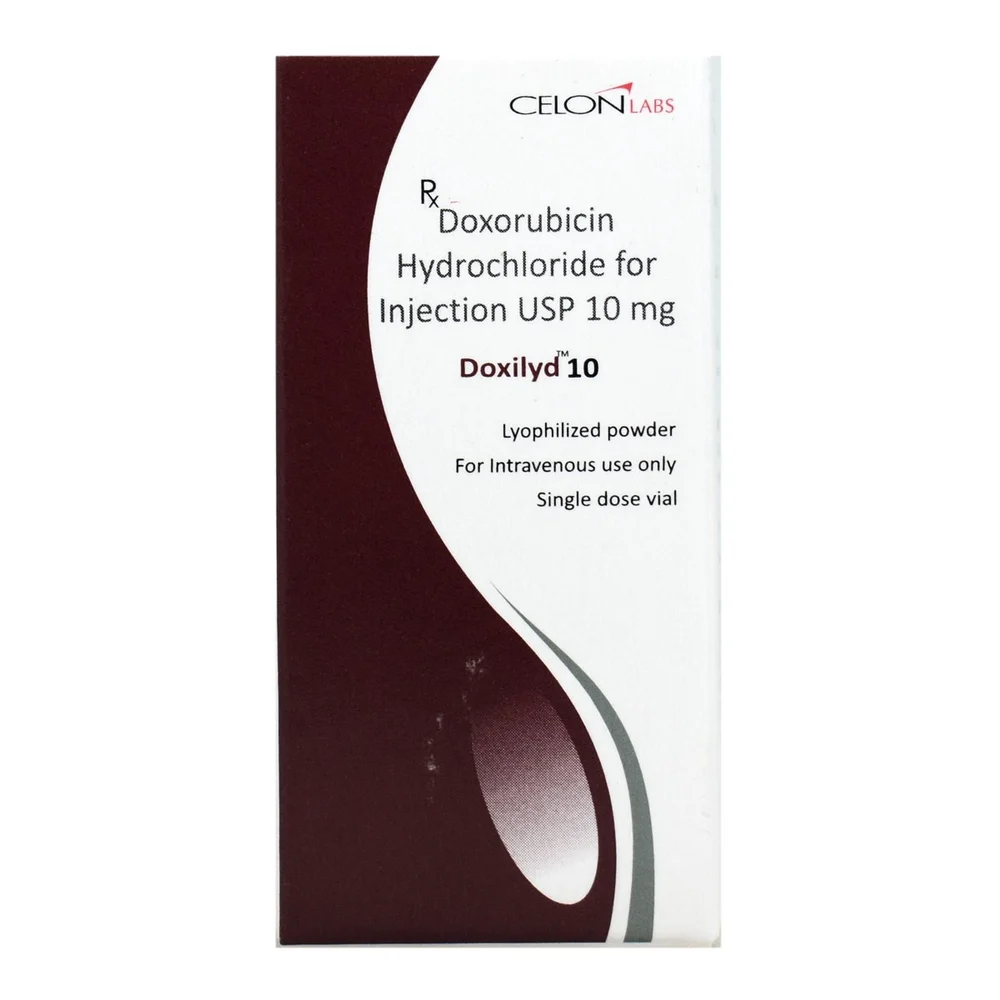
Doxilyd 10 mg Injection
Overview
Doxorubicin Hydrochloride 200mg Injection is a medicine used for treating various cancers. The active component of this drug is doxorubicin. The medicine works by inhibiting the growth and division of cancer cells by interfering with their DNA and the action of the enzyme topoisomerase II. Even though doxorubicin hydrochloride 200mg injection is an effective medicine for chemotherapy, it has several adverse reactions, which include reduced numbers of blood cells and heart toxicity, especially with high cumulative doses.
However, the 200mg vial dosage does not imply that all patients will be prescribed 200mg. The dosing will depend on many factors such as body surface area, regimen, organ functions, and exposure to the anthracyclines. Doxorubicin injection should be administered only by oncologists; also, extra care must be taken when administering this medicine because extravasation of the medicine can result in significant tissue injury.
Quick Product Facts
| Field | Publication wording |
|---|---|
| Brand | doxorubicin hydrochloride |
| Generic / Active Ingredient | Doxorubicin Hydrochloride |
| Strength | 200 |
| Dosage Form | Injection |
| Manufacturer / Marketer | pfizer |
| Pack Size | 1 |
| Prescription Required | Yes |
| Therapeutic Categories | Cancer Medicines |
| Uses | Ovarian Cancer |
Uses and Indications
Doxorubicin injection is an effective chemotherapy drug that can be part of various treatment protocols, both curative and palliative, depending on whether the drug is used to treat or control advanced cancer. It can be applied for:
- Breast cancer: As a component of anthracycline-based regimens like AC.
- Hodgkin's lymphoma: As a component of the ABVD regimen.
- Aggressive B cell lymphomas: As a component of CHOP-based chemotherapy regimens.
- Acute leukemia: In treatment protocols for certain acute leukemia.
- Soft tissue and bone sarcomas: For certain sarcomas.
- Other cancers: Selected ovarian, bladder, thyroid, and other cancers.
The specifics of using a doxorubicin 200mg injection will depend on the particular type and stage of cancer, the objective of treatment, and the patient’s condition. However, the previous administration of doxorubicin injection, daunorubicin, epirubicin, and other anthracyclines should be taken into account due to the increased risk of cardiotoxicity with total exposure to this drug class.
How Doxorubicin Hydrochloride 200mg Injection Works
Doxorubicin 200mg injection functions by interfering with the DNA of cancerous cells, preventing them from reproducing. It works by penetrating the cancer cell and disrupting the structure of its DNA and by inhibiting the activity of topoisomerase II, an enzyme responsible for DNA replication. As a result, the DNA experiences significant damage, which is impossible to repair by the cell. Moreover, doxorubicin injection is capable of generating free radicals and causing further harm to the cell.
Clinical Evidence for Doxorubicin Hydrochloride 200mg Injection
Anthracycline breast-cancer evidence: It is clear from large-scale studies and meta-analyses that anthracycline chemotherapy with drugs like doxorubicin 200mg injection can be used effectively in the treatment of breast cancer in appropriate patients.
ABVD/CHOP evidence: Long-term clinical evidence from studies has demonstrated that doxorubicin injection-based chemotherapies like ABVD for Hodgkin's disease and CHOP for aggressive non-Hodgkin lymphomas can play a key role in treatment.
Side Effects of Doxorubicin Hydrochloride 200mg Injection
There are many potential side effects associated with Doxorubicin Hydrochloride 200mg Injection, which can be either common or severe side effects that need medical attention.
Common side effects
- Nausea
- Vomiting
- Hair loss
- Mouth sores
- Fatigue
- Neutropenia
- Anemia
- Temporary red/orange urine
Serious side effects requiring prompt medical attention
- Cardiomyopathy/heart failure
- Severe neutropenic infection or sepsis
- Severe tissue injury after extravasation
- Secondary AML/MDS
- Severe liver dysfunction
Critical Safety Warning
CARDIAC TOXICITY + EXTRAVASATION: Doxorubicin 200mg injection may lead to serious cardiac toxicity, including cardiomyopathy, and this will depend on the cumulative dose of the drug. In case of pain, burning sensation, redness, and swelling around the injection site of IV, one should inform the healthcare provider promptly, since leakage of the drug out of the vein may cause extensive tissue damage.
Doxorubicin Hydrochloride 200mg Injection Dosage and How To Take It
Clinical context | Typical labelled / protocol guidance |
Dose principle | The doxorubicin injection dose is usually decided based on mg/m² (body surface area). The 200 mg refers only to the vial strength and is not the standard patient dose. |
Common single-agent dose | In some treatment settings, doxorubicin injection may be given at approximately 60–75 mg/m² IV every 21 days. |
Combination regimens | In AC, ABVD, CHOP, and other chemotherapy regimens, doxorubicin 200mg may be given at different and usually lower doses. |
Liver dysfunction | If bilirubin levels are elevated or liver function is impaired, the doxorubicin 200mg injection dose may need to be reduced. |
Important: The actual dose is decided by the oncologist based on the cancer type, treatment regimen, body surface area, liver function, and previous anthracycline exposure.
Doxorubicin Hydrochloride 200mg Injection Missed Dose
If an infusion is missed, contact the oncology department. Do not make up or reschedule the dose yourself. The team will reassess blood counts, infection status, cardiac risk and organ function before setting the next treatment date.
Safety Advice for Doxorubicin Hydrochloride 200mg Injection
| Category | Status | Guidance |
|---|---|---|
| Pregnancy | Avoid | Doxorubicin 200mg is dangerous to the development of the fetus. However, effective contraception must be used according to the healthcare professional's recommendation. |
| Breastfeeding | Avoid | Follow the instructions provided on the current product label concerning how long breastfeeding must be stopped. |
| Heart | High caution | Heart function may be assessed before and during therapy. |
| Liver | Monitor | Liver impairment may cause increased levels of doxorubicin 200mg in the body, which can increase the risk of side effects. Dose adjustment may be required based on liver function. |
| Driving | Caution | Do not drive if you feel too fatigued, nauseous, or dizzy while using Doxorubicin Hydrochloride 200mg Injection. |
Monitoring During Doxorubicin Hydrochloride 200mg Injection Treatment
- Blood tests are performed while using Doxorubicin Hydrochloride 200mg Injection to test for red blood cells, white blood cells, and platelets.
- The function of the heart can be tested through LVEF in order to assess the working of the heart.
- Tests for the functioning of the liver are performed along with the tests for bilirubin.
- The injection site for the IV should be tested for any pain, burning sensation, redness, or swelling.
- The overall amount of exposure to anthracycline drugs is calculated since it increases the chance of developing heart problems.
Doxorubicin Hydrochloride 200mg Injection Fact Box
| Parameter | Verified / publication wording |
|---|---|
| Brand | Doxorubicin Hydrochloride 200mg Injection |
| Generic | Doxorubicin |
| Strength | 200mg |
| Form | Injection |
| Manufacturer / Marketer | Pfizer |
| Pack | 1 vial |
| Storage | Store it to refrigerator at 2°C to 8°C, protect it from light, and do not freeze. |
| Prescription | Required |
| Self-treatment | Not appropriate, it is important to follow specialist prescription |
| Major safety theme | CARDIAC TOXICITY + EXTRAVASATION |
Doxorubicin Hydrochloride 200mg Injection Drug Interactions
| Drug / Class | Risk | What To Do |
|---|---|---|
| Trastuzumab/other cardiotoxic therapy | May increase the risk of heart problems. | The doctor may plan the treatment carefully and monitor heart function. |
| Other myelosuppressive drugs | May increase the risk of low blood cell counts. | Regular blood tests may be needed to check blood cell levels. |
| Live vaccines | May increase the risk of infection. | Avoid live vaccines unless the doctor specifically recommends them. |
FAQs About Doxorubicin Hydrochloride 200mg Injection
Is Doxorubicin Hydrochloride 200mg Injection 200 mg the whole patient dose?

No. The vial contains 200 mg, but the prescribed dose is calculated according to the chemotherapy schedule.
Why is an echocardiogram needed?
An echocardiogram assesses the functioning of the heart before and during administration of the doxorubicin 200mg injection. It enables early diagnosis of heart muscle weakness, which might be at an elevated risk due to increased amounts of Doxorubicin Hydrochloride 200mg Injection.
Why can urine look red while using Doxorubicin Hydrochloride 200mg Injection?
The doxorubicin injection may cause the urine to become orange or red as it is eliminated from the body via urine. This effect on urine is transient and will only last for one to two days.
What if the IV site burns?
Tell the nurse or doctor immediately because extravasation can seriously damage tissue.
Does Doxorubicin Hydrochloride 200mg Injection always cause hair loss?
Not necessarily. Doxorubicin Hydrochloride 200mg Injection may lead to hair loss; however, this side effect is not experienced by all patients. The severity of hair loss may vary from person to person.
Can doxorubicin 200mg Injection be given at home?
No. Doxorubicin Hydrochloride 200mg Injection requires specialist IV administration at a hospital or clinical setting for safe and effective treatment.
Why are blood counts checked while taking Doxorubicin Hydrochloride 200mg Injection?
Blood tests are done since doxorubicin hydrochloride 200mg injection can reduce the number of red blood cells, white blood cells, and platelets. These tests enable the doctors to identify any low blood count, which can cause anemia, infections, and bleeding.
References
- Bartlett, N. L., Niedzwiecki, D., Johnson, J. L., Friedberg, J. W., Johnson, K. B., Van Besien, K., ... & Canellos, G. P. (2007). Gemcitabine, vinorelbine, and pegylated liposomal doxorubicin (GVD), a salvage regimen in relapsed Hodgkin's lymphoma: CALGB 59804. Annals of Oncology, 18(6), 1071-1079. https://www.sciencedirect.com/science/article/pii/S0923753419379189
- Dunleavy, K., Fanale, M. A., Abramson, J. S., Noy, A., Caimi, P. F., Pittaluga, S., ... & Wilson, W. H. (2018). Dose-adjusted EPOCH-R (etoposide, prednisone, vincristine, cyclophosphamide, doxorubicin, and rituximab) in untreated aggressive diffuse large B-cell lymphoma with MYC rearrangement: a prospective, multicentre, single-arm phase 2 study. The Lancet Haematology, 5(12), e609-e617. https://pubmed.ncbi.nlm.nih.gov/30501868/
- Bisht, A., Avinash, D., Sahu, K. K., Patel, P., Das Gupta, G., & Kurmi, B. D. (2025). A comprehensive review on doxorubicin: mechanisms, toxicity, clinical trials, combination therapies and nanoformulations in breast cancer. Drug Delivery and Translational Research, 15(1), 102-133. https://europepmc.org/article/MED/38884850
- Santoro, A., Tursz, T., Mouridsen, H., Verweij, J., Steward, W., Somers, R., ... & Rankin, E. (1995). Doxorubicin versus CYVADIC versus doxorubicin plus ifosfamide in first-line treatment of advanced soft tissue sarcomas: a randomized study of the European Organization for Research and Treatment of Cancer Soft Tissue and Bone Sarcoma Group. Journal of Clinical Oncology, 13(7), 1537-1545. https://pubmed.ncbi.nlm.nih.gov/7602342/
- Speth, P. A. J., Van Hoesel, Q. G. C. M., & Haanen, C. (1988). Clinical pharmacokinetics of doxorubicin. Clinical pharmacokinetics, 15(1), 15-31. https://pubmed.ncbi.nlm.nih.gov/3042244/
Marketer Details
Pfizer
Author Details

Written By:
Nonish Sharma
I am a medical content writer with a strong academic background in life sciences, holding an M.Sc. in Biotechnology... Read More

Reviewed By:
Vaibhav Shakya
Dr. Vaibhav Shakya, MD, is a Medical reviewer and medicine expert at Globans Pharma, with more than 9 years of experienc... Read More
Want to know More
Check our Editor Policy
Disclaimer
Globanspharma main goal is to ensure that its consumers get correct, authentic, and reliable information that has been examined by medical professionals. This website's content has only been created for informational purposes. However, this is not meant to replace the medical advice and treatment given by a qualified physician. The information presented herein may not cover everything about particular lab tests, medicines, and health conditions, all possible side effects, and warnings. Please discuss all your queries related to any medication and illness with your doctor. We intend to support and maintain the doctor-patient relationship, not to substitute it or take its place.